10 Construction Site Theft Prevention Strategies
Construction sites are among the most targeted locations for theft and vandalism. With expensive equipment, open access areas, and limited overnight supervision, jobsites create the perfect opportunity for criminals.
In 2026, construction site theft prevention is no longer optional—it’s essential for protecting assets, timelines, and project profitability.
From stolen machinery to copper wire stripping, even a single incident can delay projects and cost thousands. This guide covers 10 proven strategies to reduce risk, improve site security, and protect your investment.
Strategy 1: The Jobsite Theft Crisis Statistics
Construction site crime is on the rise, particularly as the size of construction sites is increasing, along with the value of the equipment used in the sites. In most cases, the crime is committed on a weekend or at night, especially when the site is not in use.
It is vital to understand the extent of the problem in order to implement the best measures to prevent crimes in construction sites. For instance, the construction industry is providing data on the seriousness of the problem, which is evident in the high rate of jobsite crimes.
- Statistics on Construction Site Crime in the United States
- More than 1 billion dollars’ worth of construction equipment is stolen every year.
- 1 out of every 10 construction sites is a victim of crime every week.
- Some of the common stolen items are copper wire, generators, excavators, and power tools.
- Only 21% of stolen items are recovered.
It is evident that basic measures are not sufficient to prevent crimes in construction sites. Therefore, a combination of measures is required to prevent crimes in such sites.
Lockable Gates and Vehicle Barriers
Every construction site should have proper entry and exit gates. This is because proper gates help in controlling the number of people accessing the site.
Examples of proper gate security:
- Heavy-duty gates, which can be closed and locked properly
- Steel barriers, which can be used to prevent vehicles from accessing the site without permission
- Proper locks, which cannot be easily cut or broken
The gates should always be closed and locked when the site is not in use. This is to reduce the risk of theft, especially during nights, weekends, and other days when the site is not in use.
Eliminate Gaps and Weak Points
Small gaps in the fencing may be a way for thieves to gain entry into the site. It is therefore essential to check the fencing and repair any weaknesses.
Security experts recommend:
- No gaps larger than 12 inches
- Regular inspection of all fencing
- Quick repairs of any damage or wear
By maintaining the fencing, a strong barrier is maintained, and the site remains secure and not vulnerable to any theft.
Strategy 2: Motion-Activated Lighting
Dark construction sites are more likely to attract thieves. Poor lighting makes it easy for criminals to move around without being seen and reduces the effectiveness of security cameras.
Installing motion-activated lighting improves visibility and helps scare off intruders. When lights turn on suddenly, it draws attention and makes the area less appealing to criminals.
Use High-Lumen LED Floodlights
Bright lighting helps thieves hide less effectively. For instance, LED floodlights are a reliable lighting solution when you have a large job site.
An effective lighting setup consists of:
- LED floodlights with a minimum of 3000 lumens
Wide illumination of the entire area - Installation of the lights around the entrance
- points, storage areas, and walkways
LED lights are not only reliable but also environmentally friendly. They are long-lasting and thus a great security solution without increasing costs.
Solar-Powered Lighting for Remote Sites
There may also be construction sites located in remote areas, where power may be scarce. In such cases, solar lights can be a reliable option.
There is no need for power lines to use solar lights. For example, solar lights can charge during the daytime and turn on at night.
The benefits of solar lights:
- There is no need to install electrical wires.
- Installation and operating costs are low.
Therefore, solar lights can be used for remote construction sites.
Timer Circuits for Overnight Operation
Automated lighting ensures the construction site is secure without any manual intervention. Hence, it is a simple method to implement timer circuits.
Timer circuits are used to control when lights are switched on and off. For instance, it can be configured to:
- Switch on at sunset
- Stay on through the night
- Switch off during the day to avoid unnecessary usage
In this way, there is constant lighting at night, even without any manual intervention.
Strategy 3: Lockable Tool Cages
Small tools are often the most stolen items on a construction site. Even small thefts can cause delays in work in case major tools are stolen.
Lockable tool cages are helpful in protecting tools and materials. For instance, they can provide a secure place to store valuable tools when the site is not in use.
Use Steel Storage Containers
Steel containers are one of the most secure storage solutions available. They are robust, durable, and very convenient to use in different areas of the site.
Some of the major benefits are:
- Highly secure against burglary
- Provide protection against rain, dust, etc.
- Convenient to place in different areas of the site
Therefore, a number of contractors are using shipping containers to store their tools and equipment.
Install Heavy-Duty Padlocks
It is easy for a standard lock to be broken or cut. Therefore, it is necessary that padlocks be heavy-duty.
Security experts recommend:
- Padlocks with a shackle of at least 50 mm of hardened steel
- Weather-resistant padlocks for use outside
- Anti-cut and anti-drill padlocks for extra security
It is therefore important that heavy-duty locks be used, as it becomes difficult for thieves to access the site and for tools and equipment to be stolen.
Maintain Daily Inventory Checklists
Tracking tools and equipment can also help identify any possible theft. Therefore, daily inventory checks are a requirement for every construction site.
The basic process can be:
- Counting tools and equipment at the beginning and end of every working shift
- Recording any missing tools and equipment immediately
- Assigning the task to the supervisors or team leaders
This can help identify any possible theft early, and the chances of recovering the stolen tools and equipment are high.
Strategy 4: GPS Equipment Tracking
Heavy machinery such as excavators and loaders is often the target of theft. Once stolen, the equipment is often taken to other locations. Therefore, the tracking of the equipment is of great value.
The GPS tracking system helps contractors keep their equipment under surveillance in real time. This helps in improving security.
Real-Time Location Monitoring
GPS trackers also offer constant updates on the location of the equipment. For instance, the GPS trackers can:
- Provide updates on the movement of the equipment in real time
- Send notifications in case the equipment is moved without permission
- Help in responding quickly in the event of theft
This, therefore, enables the contractor to respond quickly and increase the chances of recovering the stolen equipment.
To make the GPS tracking system even more effective, some construction companies have incorporated advanced security services such as remote guarding. This is a security solution that incorporates smart cameras and security personnel to offer 24/7 coverage.
This solution can detect suspicious activity, send instant notifications, and even warn the perpetrator through audio. This, therefore, enables the contractor to not only track stolen equipment but also to prevent the theft from occurring in the first place.
Additionally, it offers complete coverage of critical areas such as the entry point, storage, and location of the equipment. This, therefore, enables the contractor to not only track stolen equipment but also to prevent the theft from occurring in the first place.
Geofencing Alerts
Geofencing establishes a virtual boundary around a construction site. It is, therefore, useful in managing the movement of equipment at any particular time.
In case the equipment crosses the boundaries, immediate action is taken. The action may involve:
- Sending a message to the supervisor
- Conducting a prompt investigation
- Notifying the security forces or police
Geofencing goes hand in hand with GPS tracking to enhance the management of valuable equipment. The contractor will be able to define a safe zone for equipment, which will send a notification if the equipment goes beyond the defined zone.
This becomes important during the weekend or at night when the equipment is not being used. It also becomes instrumental in detecting any unauthorized usage of equipment by employees or other individuals.
It becomes difficult to move equipment without being noticed, which enhances the chances of recovery in case of theft.
Improved Recovery Rates
Police can also use this information to recover stolen construction equipment. Therefore, having this information can make a big difference in case of a theft.
If construction contractors share their locations, police can take prompt action. For example, police can use the following information from GPS:
- Determine the path taken by the stolen construction equipment
- Locate and recover the stolen construction equipment faster
- Improve the chances of capturing the thieves
The police can also use this information as evidence, which will make it easier to prove ownership and track the movement of the construction equipment.
Consequently, this improves the recovery of construction equipment, reduces losses, and provides contractors with better control over their assets. Over time, using GPS tracking is a standard requirement to protect valuable construction equipment.
Strategy 5: 24/7 Remote Video Monitoring
Traditional CCTV cameras only capture images, but they do not prevent the commission of a crime. This has led to the use of remote video monitoring, especially in construction sites, to enhance security.
Remote video monitoring is a powerful security solution because it offers real-time video and immediate response. Security personnel can monitor the site at all hours and respond quickly to anything suspicious.
Connect Existing Cameras to Monitoring Centers
It is easy for remote monitoring services to connect into your existing camera system. For instance, this type of system has a number of advantages, including:
- No need to buy additional cameras
Centralized monitoring by trained security professionals - Continuous monitoring of all activity at the jobsite
- It also allows for instant alerts and enables security personnel to respond quickly, including warning the perpetrator of a crime via audio.
Thus, a passive security system, such as a CCTV system, becomes an active security system, which prevents crime rather than simply capturing it after it has been committed.
Live Agent Response Within Seconds
This is in contrast to normal CCTV systems, where the only thing done is the monitoring of the video feed. This is the reason why threats can be addressed in real-time and not in retrospect.
When suspicious activity is noticed, the agents take immediate action on it. This includes:
- Reviewing the video feed in real-time
- Determine whether the activity is a real threat
- Take action, such as issuing a warning or notifying the authorities
This is because, in most cases, the agents can take action in as little as 30 seconds. Some systems even allow the agents to communicate with the perpetrator through loudspeakers, which can help in preventing theft even before it begins.
Significant Theft Reduction
Remote monitoring is effective as a deterrent and a response system. This makes it more effective than using conventional cameras.
This is because, when thieves see a place being monitored, they will not dare to steal. For instance, it has been proven that:
- Up to 90% of theft attempts can be prevented
- Intruders will retreat upon realizing the place is being monitored
- Law enforcement agencies can quickly respond to alarms
Moreover, remote monitoring reduces false alarms because only verified threats are acted upon. This is unlike conventional systems, where false alarms may waste time.
This makes construction sites more secure, with reduced theft cases and quick response to threats.
Strategy 6: Controlled Access Points
Uncontrolled entry points can pose a great security risk. It is, therefore, essential to control the number of ways people access and exit the construction site.
When access is not controlled, anybody can access the site without being screened. This poses a risk of theft, vandalism, and accidents. Controlling access makes everyone accountable, as everyone and everything can be traced.
Single Entry and Exit Gate: Using a single point of entry and exit into the construction site makes it easy to keep track of everything. For instance, a centralized entry and exit point enables the security team to:
- Keep track of everyone accessing and leaving the site
- Keep track of vehicles accessing the site
- Keep track of suspicious activity
This reduces the chances of confusion, especially during peak hours such as the time of shift changes and the arrival of goods at the site.
Add Access Control Systems: To increase security, some sites incorporate access control systems. These systems ensure that only authorized personnel are granted access to a particular area.
The various tools used in access control systems include:
- ID badges or key cards for workers
PIN systems - Biometric systems, which may involve
- fingerprints or facial recognition
These tools help create a digital record of those who entered the site. This way, if something goes wrong, it becomes easier to investigate the matter.
Use of Security Personnel or Remote Monitoring: The use of security personnel at the points of entry is another security layer. The security personnel can check the identification of the people entering the business or confirm the delivery of the goods.
Remote monitoring systems can monitor the points of entry using cameras and alert the relevant people in the event of unauthorized entry.
This means that the controlled points of entry not only enhance security but also safety, orderliness, and efficiency.
Employee Badge Systems
Identification badges assist in making sure that only authorized workers access the construction site. Therefore, identification badges play a crucial role in access control and security.
Identification badges make it easy to identify workers and staff members who should access the construction site and those who should not. Workers can simply display their identification badges when entering the construction site, thus making it easier to identify those authorized to access the construction site.
The benefits of using identification badges include:
- Easy identification of workers and staff members
- Easy restriction of access to specific areas of the construction site based on the role of the workers and staff members
- Easy monitoring of workers and staff members’ attendance and working hours
Identification badges may also incorporate access control technologies, including card readers and scanners. Therefore, identification badges can limit access to specific areas of the construction site to authorized workers and staff members. It can also record the workers and staff members entering the construction site.
Identification badges may also incorporate color-coding, thus making it easier for supervisors to identify workers, staff members, and other individuals entering the construction site. Therefore, identification badges make the management of construction sites easier and help to improve safety.
Visitor Logs and Escorts
It is, therefore, necessary that visitors be monitored and tracked while at a construction site. It is for this reason that a good visitor process is necessary for the security and safety of a site.
Without a good tracking system, it becomes difficult to account for the people at a site. This may lead to a number of security risks, including theft and accidents.
Some of the measures necessary for a good visitor process include:
- Having a log book for the tracking of the information of the visitors and the reason for the visit
- Issuing of temporary identification badges for easy identification of the visitors
- Having authorized personnel escort the visitors at all times
This ensures that the visitors are only in authorized areas and cannot access restricted areas such as equipment storage or restricted workspaces.
It is, therefore, necessary that a good visitor process be put in place for the security and safety of a site.
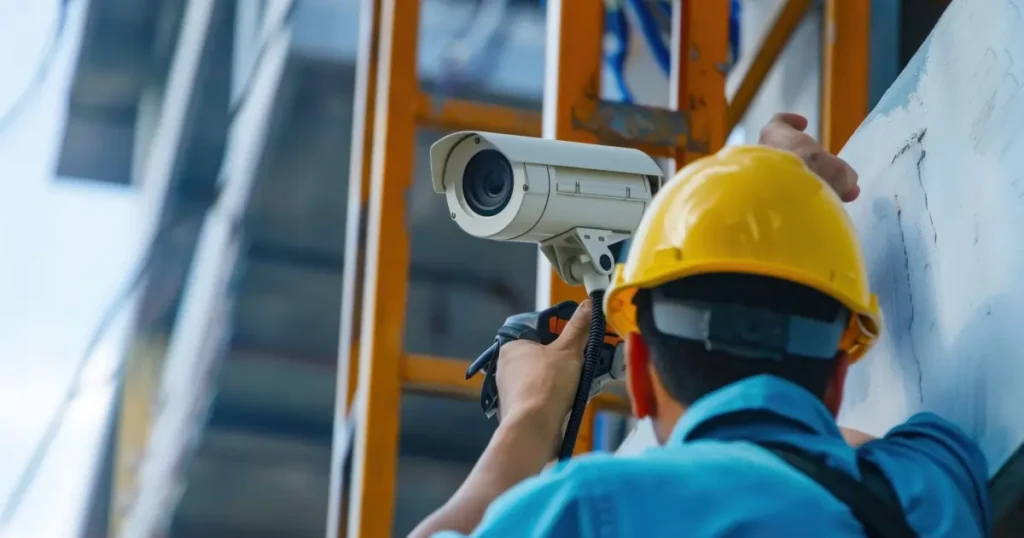
Strategy 7: Visible Surveillance Cameras
Security cameras have the ability to function as both monitoring devices and effective deterrents. Therefore, construction sites with cameras installed and where the cameras are visible are less likely to be targeted by criminals.
This is because people who know they are being watched will be less likely to visit the area.
Placement is vital in order to achieve the best out of your security cameras.
Elevated Camera Mounting
Cameras must be mounted at a height of 25 to 35 feet. This is because this position provides better protection.
For instance, cameras mounted at this height:
- Help prevent damage
- Provide a larger area of the site
- Provide better visibility
This position of the cameras is beneficial in the sense that blind spots are eliminated. This means more areas of the site can be monitored with fewer cameras.
Besides this, cameras mounted at a higher position provide a better view of the areas where equipment is placed and the open work areas.
This means that cameras mounted at the correct position enhance the efficiency of the cameras in the security of the site.
Clear Security Signage
Security signs are of great importance in the prevention of crime. This means that, at a construction site, security signs should be placed in a way that warns people of the existence of security monitoring.
This way, people are aware that the site is being monitored and, therefore, crime is prevented before it even happens. This is because, by seeing the signs, people are already aware of the security measures in place.
Some of the security signs that should be placed at a construction site include:
- “24/7 Video Surveillance”
- “Security Monitoring in Progress”
- “Authorized Personnel Only”
- “No Trespassing”
It is, therefore, important that these signs be placed in strategic areas such as the entrance gates, storage areas, and areas where valuable equipment is stored.
For the signs to be of great importance, it is important that they be placed in a way that people approaching the site are aware of the security measures in place. This means that the signs should be large and easily readable, even at a distance.
Additionally, it is possible for you to include a contact number on the signs, which enables people at the site to report any suspicions of crime.
For this reason, security signs are an effective deterrent. They can be used as a support for other security measures. They can also be used to prevent theft and unauthorized access.
Flashing LED Indicators
Some of the security cameras come equipped with small LED lights that are visible, indicating that they are in use. Therefore, they provide an additional layer of deterrents, especially on construction sites.
These small lights on the cameras are very helpful, especially in environments with low lighting. When people see the cameras, they are likely to think that they are being monitored in real-time.
The benefits of this include:
- Proving the cameras are working and recording
- Increasing visibility, especially during the night or in poor lighting
- Emphasizing the effectiveness of the security system
The LED indicators also assist in easily locating the cameras. This can, in turn, promote awareness and hence safe conduct within the facility.
On other occasions, the use of flashing LEDs, coupled with appropriate signage and illumination, can make the cameras even more effective.
The cameras, therefore, act as a deterrent and can prevent theft before it actually takes place.
Strategy 8: Employee Training Protocols
Technology, in itself, is not a guarantee against construction site theft. Therefore, it is essential to ensure that employees are trained to adhere to proper security protocols each and every time.
Well-trained employees can easily identify suspicious activities, report potential threats, and assist in creating a conducive environment. This is because, when everyone is aware of what is required, the chances of theft and errors are minimized.
Training sessions should be held regularly, focusing on the basics of security, responding to emergencies, and dealing with suspicious situations. This is because communication is the key, and everyone must be aware of the protocols.
End of Day Lock Up Procedures
Before leaving the site each day, a simple security checklist should be followed. For instance, the checklist could include:
- Locking all tool storage areas
- Securing all equipment and materials
- Switching off and/or shutting down all machinery
- Checking and locking all gates and entry points
This could be done by designating a particular team member to be in charge of each aspect, so nothing is overlooked.
Additionally, reporting any problems, such as faulty locks, missing tools, and damaged fences, could be part of the checklist.
This way, the lock-up procedure each day would address security loopholes, accountability, and the security of the site even after work hours.
Suspicious Activity Reporting
Employees should be encouraged to report anything unusual observed in the construction site. It is for this reason that a strong reporting culture should be emphasized in the context of a construction site.
Employees are often the first to identify unusual activities observed in the construction site. The early reporting of unusual activities enables the company to take action before the activities escalate to theft.
Examples of unusual activities observed in a construction site include:
- Unidentified cars parked near the construction site
- People taking pictures of the equipment
- People trying to access restricted areas without authorization
To improve reporting, companies should consider developing a reporting culture through various ways, including direct communication with supervisors, reporting through mobile devices, and emergency contact numbers. Employees should be made aware that reporting unusual activities is encouraged.
Employees should be trained to be vigilant to help build a strong reporting culture, which enables a proactive approach to a company’s security.
Early reporting of unusual activities observed in a company’s construction site enables a company to respond to unusual activities, which helps prevent any potential theft from occurring.
Background Screening
Having trustworthy workers can mitigate internal security risks. Therefore, a background check is a vital aspect before allowing workers on a site under construction.
Not all risks come from outside sources. In some instances, the risks are from people already on the site. A thorough check can mitigate such risks in advance.
Some of the basic screening measures include:
- Verification of identification documents
- Verification of work history
- Verification of reference
Additionally, employers may also wish to verify qualifications, licenses, and work history of the employees in order to ensure that the workforce is reliable and trustworthy.
Thus, it may be concluded that the process of background screening helps in creating a reliable workforce, which in turn helps in creating a safer and more secure jobsite environment.
Strategy 9: Equipment Marking Programs
Construction equipment marking helps to identify stolen items, thus making them difficult to sell. This, therefore, makes it an effective way of preventing theft.
In case the equipment has a unique identification, it becomes easier to track them. This, in turn, makes them difficult for thieves to sell, thus deterring them from stealing.
UV Invisible Ink Marking
This is a popular method of marking because it is possible to identify the equipment without the use of labels. Ink is used on the equipment, and it is only visible when exposed to ultraviolet light.
Some of the benefits of using this method of marking equipment include:
- Does not alter the appearance of the equipment
- Difficult for thieves to locate
- Easy verification of ownership by the police
This method of marking equipment is applicable to tools and machinery in the construction site.
This method of marking equipment helps in the recovery of equipment in the construction site and discourages theft.
VIN Etching on Machinery
Identification numbers on construction equipment make it difficult for thieves to sell the items. Therefore, VIN etching is a simple yet effective measure of preventing construction equipment theft.
If the construction equipment is clearly identified, it is easier to track the items. At the same time, thieves are less likely to steal identified construction equipment.
The areas of construction equipment that can be engraved include:
- Engine compartments
- Frame areas
- Key areas
These areas have been identified as difficult to alter without damaging the construction equipment.
At the same time, identification of construction equipment is a big deterrent to thieves. When thieves see identification numbers on construction equipment, they are less likely to steal the items.
Asset Inventory Databases
Detailed records of the equipment can also aid in recovery in case the equipment is stolen. Therefore, it is recommended that every construction site should maintain a database of their inventory.
A well-organized system will make it easier to track the equipment, verify the owner, and share the information with the authorities when the need arises.
A well-organized system will consist of the following:
- Serial numbers of the equipment
- Description of the equipment
- Purchase and ownership records
- Location or assigned area of the equipment
The records should be maintained and updated regularly, especially when the equipment is moved, replaced, or assigned to a different team.
Strategy 10: Professional Security Services
Large construction projects sometimes require more than the basic security measures. This has led many construction companies to consider the services of professional security services, which offer the benefits of technology and expertise.
This type of service offers the benefits of advanced security, which can be achieved through the use of experts and technology.
Remote Monitoring Across Multiple Sites
Professional security providers can monitor multiple construction sites at the same time. This is especially useful for companies that manage several construction projects in various locations.
The key benefits of using remote monitoring for construction security include:
- Centralized monitoring of various construction sites from a single control room
- Standardization of security protocols for all construction sites
- Lower staffing costs for construction security
Moreover, remote monitoring systems allow for instant alerts and responses, thus providing comprehensive security for construction sites, even during off-hours.
Faster Response Than On-Site Guards
Remote monitoring centers can react quickly if a security problem happens. As a result, they can react faster compared to conventional security guards.
Rather than waiting for a problem to be noticed, a team of security personnel monitors the cameras and acts immediately if they suspect a problem.
For example, a security team may:
- Investigate a threat in real-time using live video
- Call the police immediately
- Alert the perpetrator using speakers and alarms
In most cases, this happens within a few seconds. Fast action may prevent a crime from happening or prevent a situation from worsening.
Insurance Premium Reductions
Insurance firms may offer lower premiums for construction sites that have effective security arrangements. Therefore, this is a benefit of investing in security for a construction site.
A construction site that is well protected is less likely to experience theft, damage, or accidents. As a result, the risks for insurance firms will be lower.
Benefits may include:
- Fewer theft-related insurance claims
- Less liability risk on-site
- Greater compliance with safety and security standards
In some cases, insurers may demand specific security arrangements, including cameras, access control, and monitoring, before offering insurance or discounts.
Implementation Checklist
This is because it ensures that all the security measures in place work effectively. Therefore, it is recommended that construction sites have a daily checklist to enhance safety and minimize potential threats.
Additionally, it is essential to perform regular checks on the site to identify minor problems before they escalate into major problems. This ensures the site is always secure and all systems are running as expected.
Daily Jobsite Security Walkthrough
Before leaving the site each day, it is essential to perform a quick security walkthrough. This can include:
- Checking the site’s perimeter fence to see if it is damaged in any way
- Ensuring the motion-activated lights work correctly
- Verifying all tool cages and storage containers are closed and secured
- Verifying GPS devices are active and working correctly
- Ensuring the main access gate and all access points are closed and secured
- Ensuring all cameras are working and in plain sight
This way, the site is more secure, and potential problems are addressed before they occur.
FAQs
Construction site theft prevention requires a proactive and layered security strategy. Data shows that relying on a single method such as fencing or cameras is not enough. The most effective approach combines perimeter security, lighting, access control, GPS tracking, and real-time monitoring.
What are the biggest jobsite theft risks in construction?
Construction sites face several security risks due to their open layouts and high-value equipment. The most common risks include unsecured entry points, poor lighting during nighttime, lack of active monitoring, and remote or isolated locations. In many cases, theft also involves insider risks from workers or contractors who have access to the site. These vulnerabilities make construction sites an easy target if proper security measures are not in place.
What equipment is most commonly stolen from construction sites?
The most commonly stolen items from construction sites are those that are valuable, easy to transport, and quick to resell. These typically include copper wiring, generators, fuel, excavators, loaders, and power tools. Smaller tools are especially at risk because they can be removed quickly without drawing attention, while heavy machinery is often targeted in planned theft operations.
How effective is construction site theft prevention?
Construction site theft prevention is highly effective when multiple security layers are used together. Measures like fencing, lighting, surveillance cameras, and remote monitoring significantly reduce theft incidents. Sites that combine these strategies often see major improvements, with some reducing theft risks by more than half. A proactive approach not only prevents theft but also improves overall site safety and control.
Why is construction site theft recovery so low?
Recovery rates for stolen construction equipment are generally low because many sites lack proper tracking and identification systems. Equipment is often not marked, GPS tracking is not installed, and thefts may not be reported immediately. As a result, stolen items are quickly transported or sold before authorities can act. Without clear identification or real-time tracking, recovery becomes very difficult.
Does lighting really prevent construction site crime?
Yes, proper lighting plays a major role in preventing construction site crime. Well-lit areas make it harder for criminals to operate unnoticed and increase the chances of being detected. Motion-activated lighting is especially effective because it immediately exposes movement, which can scare off intruders. Lighting also improves the performance of surveillance cameras, making it an essential part of any security plan.

Security content creator with OHZ Remote Guarding, focusing on advanced asset protection strategies during extended business closures and seasonal risks.
Related Reads