How to Choose the Right Commercial Property Security System
Learn how to choose the right commercial property security system with alarms cameras access control and remote monitoring.
A security system for a commercial property has to take into account a number of different factors, including the number of people that will be using the property, the type of traffic that there will be, and the presence of nearby highways, transit routes, ports, and industrial or downtown areas. Even if a property is in a residential area, it will still need a commercial property security system.
A security system for a commercial property is not just about putting in place a number of different cameras, alarms, and locks. Instead, it has to be a coordinated system that will deter crime, detect and respond to incidents of crime early, and, where necessary, provide verification of what is going on and support for the response to that crime. In providing a commercial property security system, OHZ Security can provide commercial alarm systems, video surveillance, access control systems, remote guarding using AI, live video monitoring, mobile surveillance trailers, and a virtual doorman service.
Whatever the needs of a property, OHZ Security can help to evaluate the security needs of a business and to provide a number of different security options. Where a business has a number of different properties, the security needs of each property will be different, and OHZ Security can help to provide a number of different security solutions for the different properties of a single business. These could include the security needs of a number of different types of properties, including apartment complexes, construction sites, car dealerships, warehouses, and retail, office, and industrial properties.
Why Commercial Property Security Requires a Layered Strategy
At the core of any good commercial security plan is a simple question: “Do we need cameras or an alarm?” No, a better question would be “What do we need to prevent, detect, verify, and respond to security events?”
A single tool to solve all of these is rare and usually does more harm than good. For example, recording of activity by cameras does not, in itself, stop a trespasser. Notification of an alarm event is unverified until it is checked, and in the meantime could cause a delayed response or even a false alarm. However, controlled access with proper credential management and audit trails does prevent unauthorized entry. But that, in itself, is not enough to form the basis of a security policy.
All of these need to be thought of in terms of a layered security plan and, in turn, operated as a single operational plan rather than buying a number of separate systems that do not communicate.
Step One: Start With a Commercial Security Risk Assessment
Before comparing commercial security systems, begin with a risk assessment. Although a simple risk assessment does not have to be complicated, it must be thorough. A professional assessment helps to identify potential problems, their occurrence, affected parties, and the most effective solution to reduce the risk. A thorough risk assessment will help you to compare the features of the commercial security systems offered by different suppliers.
Review Your Property Layout for Security Risks
Walk through the property during business hours, after closing time, and at night. The security conditions change quickly with changes in lighting, occupancy, and activity.
There are many potential security problems at a property, and a good commercial security system must take all into consideration. A common mistake with video surveillance installation is that cameras are often installed in the easiest locations to access. Video surveillance design should start with consideration of the activity that you need to capture: faces, license plates, movement of vehicles, attempted break-ins, package handling, etc.
Identify the Highest-Value Assets to Protect
Every business has assets of greater value than others. The highest-value assets must be protected by the security measures put in place. The vehicles, the keys, the catalytic converters, the service tools, and customer records of a car dealership. The equipment, materials, fuel, generators, and temporary power systems of a construction site. The safety of the residents, the package rooms, the parking areas, the common areas, and the controlled entrances and exits of an apartment complex.
Business alarm systems may be sufficient to protect low-value assets, but more advanced remote monitoring, stronger access control measures, etc. may be needed for higher-value assets.
Review the Incident History to Identify Patterns
Look at past incidents, no matter how minor they may have seemed at the time. Look for patterns in the security failures that have occurred. Patterns of security failures often reveal where security improvements will have the most impact.
If you do not have a formal record of past security failures, then talk to managers, maintenance personnel, tenants, front desk staff, and neighboring businesses. They will likely be able to identify where problems have occurred in the past.
Consider Time-Based Risk When Comparing Security Systems
Many security failures are caused by a system being designed for the building and not for the schedule of use of the building. A property may be of low risk of security failure during the day, but of very high risk at night. A construction site is a constantly changing environment, with gates opening and closing, with new materials arriving on a daily basis, with crews coming and going throughout the day and night. A multifamily property may have peak package theft times during the afternoon delivery times.
Live video monitoring, AI-powered remote guarding, and scheduled remote patrols can all provide greater protection during times of higher risk.
Commercial Alarm Systems
A Commercial Alarm System is the core of any business security solution. These systems can be configured to sense a number of scenarios, including but not limited to:
- Unauthorized entry
- Glass breakage
- Motion
- Door and window opening
- Panic situations
Commercial Alarm Systems can be configured to suit a number of business types and are ideal for businesses that are locked and left vacant for long periods of time and have set opening and closing times.
A Commercial Alarm System can also support video verification, which allows for remote verification of alarms via connected cameras.
The best use of a business alarm system is often as part of a wider security solution that incorporates cameras and remote verification.
Video Surveillance
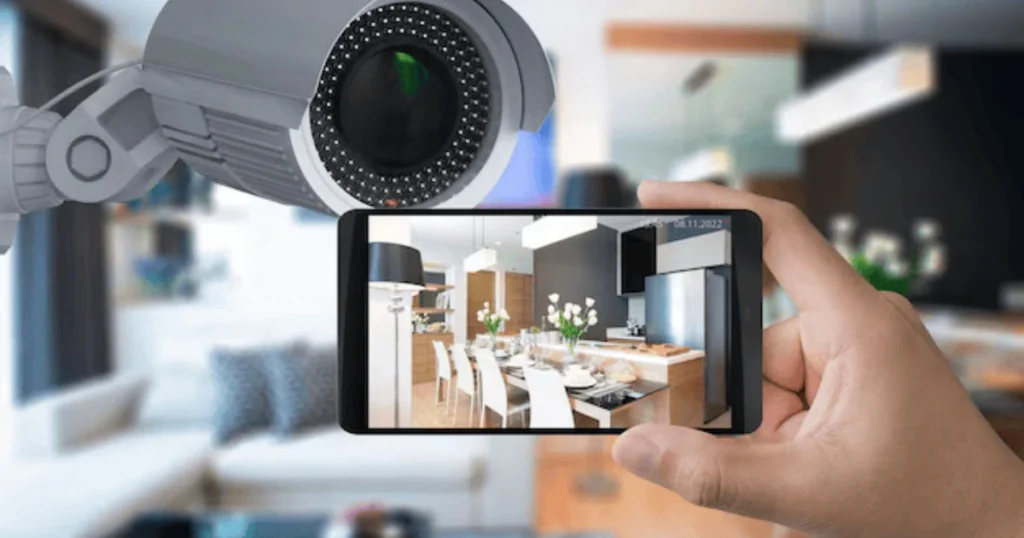
Video surveillance can be used by companies to observe, document, and investigate events that occur on the property. The commercial camera systems are advanced and consist of fixed cameras, dome cameras, bullet cameras, wide-angle cameras, license plate cameras, and even thermal cameras. The video surveillance systems can be set up to record on-site or in the cloud.
Video surveillance can be applied to nearly every type of commercial property such as an apartment complex, car dealership, parking lot, construction site, warehouse, retail store, and office building.
When businesses say that they already have cameras, the next question is whether or not they are being watched when it matters. In such cases, remote monitoring and live intervention are key.
Access Control
Access control, or how to grant access to certain areas at certain times, instead of handing out physical keys. Businesses can set up their access control by using different types of credentials (cards, fobs, etc.), PIN codes, intercoms, and visitor management.
Multifamily properties, offices, medical facilities, warehouses, schools, retail backrooms, any property with multiple employees, tenants, vendors, etc., and restricted areas.
For higher-traffic properties, Access Control is more effective when used in conjunction with video intercom, visitor screening, and a virtual doorman service.

Remote Monitoring and Live Video Monitoring
Remote monitoring by trained personnel for alert, camera, and security event detection from a remote monitoring center. Live video monitoring for verification of activity and for escalation of activity as needed.
This is very different from simply recording activity for possible after-the-fact review of an incident.
OHZ Security’s remote monitoring program provides for:
- Event-based alerting from property cameras and/or property analytics
- Live video review of any reported security incident for verification
- Audio talk-down warning(s) as needed for any incident
- Property monitoring notifications to property managers, property owners, and on-site property staff as needed
Remote monitoring is most effective for properties with after-hours exposure, outside assets, parking areas, vacant spaces, recurring trespassers, and limited on-site staffing.
OHZ Security’s remote monitoring solutions are designed with the realities of real property and its associated camera systems in mind. We can help you to detect, verify, and respond to threats to your people and property.
AI-Powered Remote Guarding
Traditionally remote guarding systems would use video monitoring and monitoring workflows that contain video analytics to identify certain events. These types of systems are not intended to act as a full security solution; however, the monitoring and video analytics can help to filter through large amounts of activity and highlight items of interest such as people, vehicles, movement, etc.
Why AI Helps – Traditional Motion Detection Alone Can Generate Alerts for All Sorts of Things
AI-powered remote guarding uses video analytics to help identify events of interest, and it’s a lot smarter than traditional motion detection, which can generate alerts for all sorts of things including:
- Shadows (caused by changes in lighting)
- Rain and wet surfaces
- Animals (including pets)
- Blowing debris (such as leaves or dust, etc.)
The use of video analytics to support remote guarding can help to reduce false alarms and ensure that the operator only receives alerts for events that are likely to be of interest. The best systems, however, are always going to be those that incorporate human review and, where appropriate, escalation rules and regular tuning.
At OHZ Security, we can help to establish whether the use of AI-enabled monitoring would be appropriate for your site and, if so, how it could be configured to support practical and responsible threat detection.
Mobile Surveillance Trailers
A mobile surveillance trailer is a portable, mobile security monitoring system that can be placed on a temporary basis to provide security on a site where fixed, wired security solutions are not available or are not practical to install.
A typical mobile surveillance trailer may include:
- Camera(s) mounted on an elevated mast (such as a column or tower)
- Lights to improve the visibility of the surrounding area
- Speakers for audio warnings
- Cellular connectivity to enable remote monitoring and support
- Solar panels or battery support to power equipment
- Remote monitoring capability
- Visible deterrent signage
A mobile surveillance trailer provides a flexible solution to security requirements, which are often changing and are only required on a temporary basis.
For New Jersey construction sites, car dealerships, and other commercial properties with outdoor spaces, a mobile surveillance trailer can provide needed security without the wait for permanent installation of security wires.
Virtual Doorman Solutions
Virtual doorman solutions combine video intercom, remote concierge support, access control, visitor verification, package workflows, and tenant communication.
Virtual doorman services are ideal for use at:
- Apartment complexes
- Multifamily buildings
- Mixed-use properties
- Professional office buildings
- Medical office buildings
- Coworking spaces
- Other properties that have controlled lobbies
Virtual doorman services require a front desk presence for resident, tenant, and staff convenience.
A virtual doorman is not just a technology installation. It is an operating model. Therefore, the best results are obtained by a property when technology, property rules, staff responsibilities, and tenant communication are all aligned.
New Jersey Commercial Property Security Considerations
Commercial properties in New Jersey are often situated in densely populated areas, which can present both opportunities and challenges for businesses.
In designing a security plan for a property in the Garden State, consideration should be given to:
- the high volume of vehicles using major roads and having access to highways
- the large number of parking spaces and shared access roads
- the mix of commercial and residential properties
- the volume of deliveries and the management of related packages
- the multi-tenant nature of many properties, with a variety of schedules and users
Because there are a variety of municipal expectations and requirements, property owners should strive to create a flexible yet compliance-oriented security policy. Where possible, best practices such as avoiding the recording of areas where there is a high expectation of privacy, the use of appropriate signage where video surveillance is in use, and the definition of video retention periods should be incorporated. Security system access should be restricted to authorized personnel, with access logs and review of permissions on a regular basis.
OHZ Security can assist businesses in thinking through the practical issues of system design, monitoring, and deployment, and we recommend that property owners work with legal counsel, insurance professionals, and municipal officials to address specific requirements that may exist.
According to legal research on mixed-use property tax exemptions, a New Jersey Tax Court ruling established that mixed-use buildings predominantly used as residential apartments can be reclassified to qualify for exemption from the state’s Mansion Tax. This reclassification allows eligible commercial real estate owners to avoid significant transfer tax liabilities when selling multi-use properties.
Security for Apartment Complexes and Multifamily Properties
Multifamily properties present a unique security challenge as they comprise individual residences, with shared community facilities, amenities, parking, and spaces for property staff to work.
For multifamily properties, the goal of security is to make secure behavior easy to do and provide evidence of activity in case of an incident. Security should never get in the way of residents’ convenience, nor compromise their privacy. Ideally, a well-designed security solution would meet or exceed these objectives.
Car Dealerships
The car dealership is a very exposed environment. It has lots of outside space to house valuable stock. There are often big areas to be covered and lots of access points. There are also service bays, key rooms, parts and tool stores, customer waiting areas, and areas where customers can drop off their vehicles after hours.
Early detection of persons entering and leaving the lot after hours is key. The system needs to be able to determine if the activity is harmless, suspicious, or of an urgent nature and escalate accordingly.
Construction Sites
Most construction sites are open and dynamic environments and difficult to secure with traditional systems such as fencing. Such sites include changing numbers of site access points, materials, and equipment. Sites often have changing numbers of fencing sections, temporary gates, lighting, and storage containers. Construction sites often lack permanent power and internet service, but require the presence of materials and equipment to complete work.
Construction security should be flexible in order to accommodate changes in the site as the project progresses. For example, cameras may need to be relocated to cover new areas, and monitoring of areas may need to be turned on and off as necessary. In addition, monitoring rules and procedures may change as the project progresses. OHZ Security can help develop a site-specific deployment plan to accommodate the dynamic nature of a construction site, as opposed to forcing the site to fit into a static security system.
General Businesses, Offices, Warehouses, and Retail Properties
General commercial properties need a system to protect people, assets, and business operations. The appropriate mix of systems depends on the type of business conducted.
For example, office buildings would require:
- Access control to entries and tenant suites
- Visitor management
- Elevator or floor access control
- Video surveillance of lobbies and parking areas
- Alarm systems for after-hours intrusion
The best business security systems are those that support the business and its operations and do not get in the way. They need to be easy to manage, easy to train others to use, and provide clear evidence of what happened during an incident.
General commercial properties need reliable security to protect people, assets, and daily operations. Retail Commercial Security Solutions can combine access control, video surveillance, visitor management, and alarm systems to provide effective, easy-to-manage protection.
How to Choose the Right Security Partner
Technology is important, but your partner designing, installing, monitoring, and supporting your security system is just as important. A poorly designed security system can cause all sorts of problems, including blind spots, false alarms, frustrated users, and confused response procedures.
When searching for a security provider, it would be wise to ask them the following questions:
- Do they complete a property-specific risk assessment?
- Can they support alarms, cameras, access control, and monitoring systems?
- Do they understand commercial property operations?
- Can they design a system to cover outside areas and changing sites?
- Do they offer live video monitoring or AI-powered remote guarding?
- Can they provide mobile surveillance trailers if a permanent system is not suitable?
At OHZ Security, we design practical commercial property security solutions that take into account the site-specific requirements, the risk, and the operational constraints of your business. Our range of solutions include remote guarding and virtual doorman solutions. We help you see what matters and respond accordingly.
When to Upgrade Your Current System
A host of commercial properties already have some security solution fitted, but often these are outdated and not connected together properly to give a true sense of security.
You may need an upgrade if:
- For example, a property may have cameras, but these are taken offline for a while and then not reconnected.
- On other occasions, the images are not clear enough, are being taken by a camera that has been moved, and so are not relevant.
- Footage is not being retained and is difficult to access.
- Even when accessed, it is not possible to export it in a usable form.
- Alarms are constantly going off, but each time there is a false alert.
- OHZ Security can provide after-hours monitoring, but the property does not have any on-site staff.
An upgrade to a property’s security does not necessarily have to mean that the whole system has to be replaced. In many cases, the coverage can be improved, monitoring can be added to, a camera or two can be repositioned, access control can be strengthened, and mobile surveillance can be provided where there are no fixed security solutions in place.
A security plan is more than just buying equipment
A security plan is more than just buying equipment; it needs to include a plan for how you respond to incidents.
These questions help to establish an effective security plan:
- What alerts do you want to generate?
- Who verifies the event?
- What actions occur first?
- Who gets contacted?
- What documentation is required after the incident?
A late-night walk through a dealership lot would likely prompt a different response than a delivery driver arriving at a warehouse gate, a resident entering an after-hours apartment lobby, or a subcontractor arriving early to start work at a construction site.
By creating monitoring protocols that prevent confusion and allow for the most effective action to take place in the shortest amount of time, OHZ Security can help to establish these security protocols before systems go live. This can include the establishment of a notification list, escalation procedures, audio warnings, and incident reporting.
Request a Security Assessment From OHZ Security
If you are evaluating business security solutions for your commercial property in New Jersey or elsewhere in the U.S., start with a professional security assessment to evaluate your options. OHZ Security can help you determine if you need commercial alarm systems, access control, video surveillance, remote monitoring, mobile surveillance trailers, AI-powered remote guarding, a virtual doorman solution, and more.
Get a security assessment to identify vulnerabilities and prioritize improvements.
Schedule a demo to see how live video monitoring and remote guarding can support your property.
Get a quote for a customized commercial security system that meets the needs of your site, your risk profile, and your operating needs.
FAQs
Get clear answers to common questions about commercial property security systems, including alarms, video surveillance, access control, remote monitoring, AI-powered remote guarding, mobile security trailers, and virtual doorman solutions.
What is the best commercial property security system?
There is no one-size-fits-all best commercial property security system because every property is different. For a small office, for example, an alarm with access control at the entrance and cameras at the entrance would be sufficient. A car dealership may need perimeter cameras with remote monitoring and after-hours audio deterrence. A construction site may need mobile surveillance trailers for flexible monitoring.
What is live video monitoring?
Live video monitoring allows trained personnel to monitor security incidents and/or view live camera images from your property. When suspicious activity is detected, the monitoring team can follow a set of predefined rules such as issuing an audio warning, contacting management, contacting on-site security (e.g., a guard), or contacting emergency services.
Are commercial alarm systems enough for business security?
When evaluating commercial security systems for business security, it is essential to ask if commercial alarm systems are sufficient on their own, or whether video verification, access control, and a response plan can enhance the effectiveness of the alarm.
How does AI-powered remote guarding work?
OHZ Security offers AI-powered remote guarding solutions, using sophisticated analytics to identify and alert users to instances of people or vehicles entering defined areas at defined times. Property-specific human review and protocols remain essential to the accuracy and effective response to alerts generated by such a system. While such systems can help prioritize alarms, care must be taken to ensure that the system is properly configured and that regular reviews take place to test the system’s performance.
When should a business use mobile surveillance trailers?
For short-term requirements or projects that involve working outdoors, a business may want to consider the use of mobile surveillance trailers, typically used for temporary outdoor security at things like construction sites, overflow parking lots, vacant properties, and external inventory areas and events. Such units are frequently deployed where there is no fixed power, internet, or mounting point at which to mount a camera, and offer a flexible and cost-effective way to meet an immediate security need.
What is a virtual doorman?
A virtual doorman provides remote visitor management and access support. Such services allow for screening of visitors, management of entries, support of residents/tenants, and front desk operation, all remotely, and can help to improve control of lobbies.
Do New Jersey businesses need special security considerations?
Businesses in New Jersey need to take into consideration the unique security issues presented by the dense traffic, shared access points, multi-tenant properties, and local municipality requirements present in many New Jersey commercial properties.
How often should a commercial security system be reviewed?
A commercial security system review is recommended for your business whenever there is a change to your property, in the event of an incident, at change of tenant, at start of construction, when there is an increase in inventory, or in the event of new access points. Many businesses also benefit from an annual review of their commercial security system.
Can OHZ Security help with both equipment and monitoring?
OHZ Security can help design and implement a security solution for your business, providing a variety of services including alarm system design and monitoring, camera system design and monitoring, access control system design and monitoring, live video monitoring, AI-powered remote guarding, mobile surveillance trailers, event-based security, and virtual doorman services.

Security content creator with OHZ Remote Guarding, focusing on advanced asset protection strategies during extended business closures and seasonal risks.